Two Sisters. Two PhDs. Two Powerful Paths. One Extraordinary African Legacy.
There are academic achievements that deserve applause.
And then there are journeys that deserve to be remembered because they inspire an entire generation to dream beyond what seems possible.
The story of Dr. Zamambo Mkhize and Dr. Zakithi Mkhize is one of those extraordinary journeys.
Two sisters.
Two scholars.
Two PhDs.
Two very different academic disciplines.
Yet one shared message: education can become a powerful instrument for transformation when knowledge is combined with courage, purpose and a commitment to creating opportunities for others.
Their journeys are particularly remarkable because neither sister simply pursued education for the prestige of qualifications.
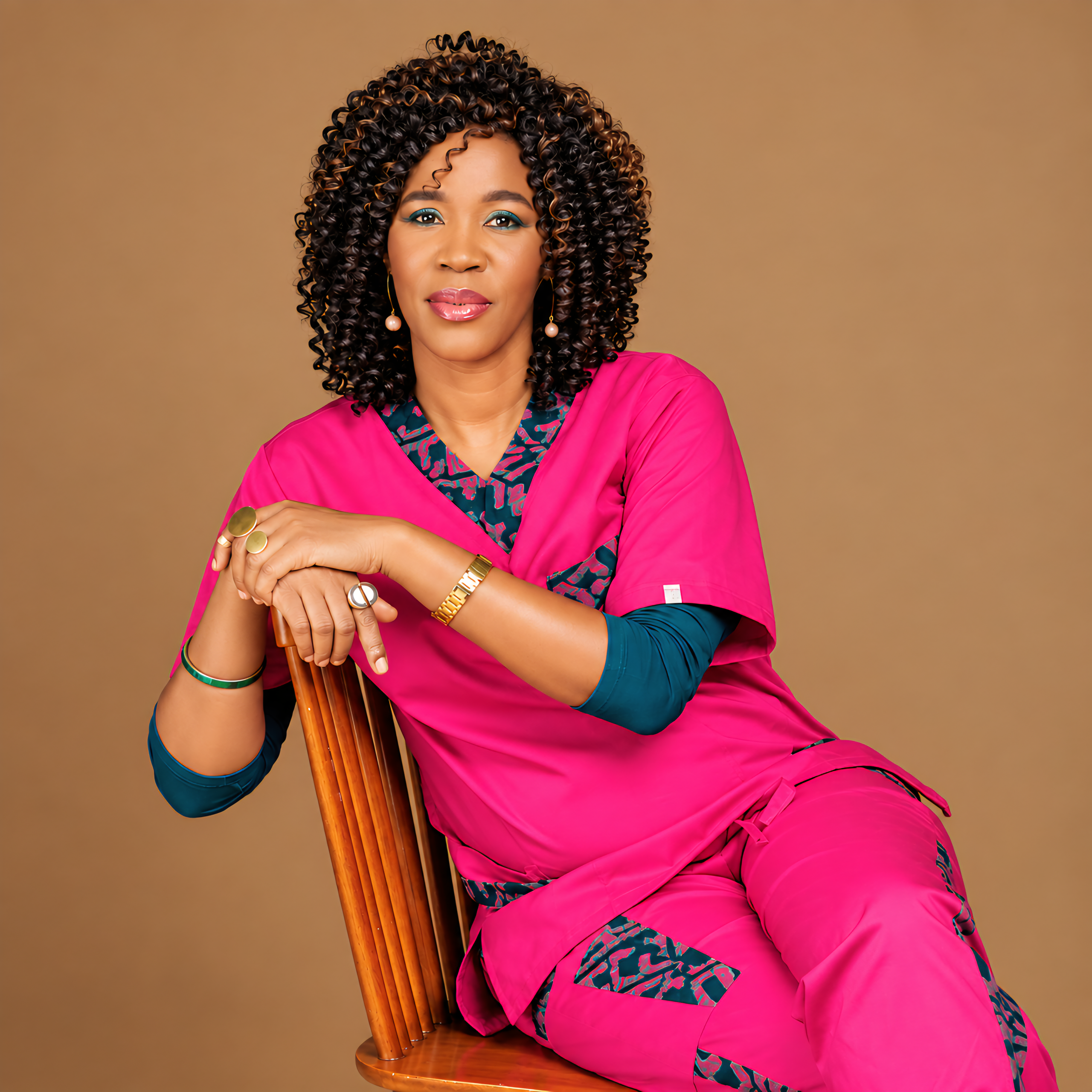
Dr Zamambo Mkhize has built a scholarly career around gender, African feminism, culture, family, law and the experiences of African women in higher education and STEM.
Dr Zakithi Mkhize has pursued the scientific route, specialising in virology and HIV research before expanding her work into science communication, medical communications, mentorship and public engagement.
Together, their journeys represent two sides of African intellectual leadership: asking difficult questions about society and developing scientific knowledge that can contribute to solving some of the continent’s most pressing health challenges.
Their story is also a powerful reminder that representation matters.
When young African girls see women who look like them earning advanced degrees, conducting research, communicating science and occupying intellectual spaces, the boundaries of possibility begin to change.
Dr. Zamambo Mkhize: The Scholar Challenging the Boundaries of Gender, Culture and Power
Dr. Zamambo Mkhize is a South African academic, researcher, author and advocate whose scholarship examines some of the most complex intersections of gender, culture, family, race and higher education.
She is a Senior Lecturer in African Feminist Studies at the University of Cape Town, within the School of African and African Feminist Studies, Anthropology and Linguistics.
Her intellectual journey began internationally.
She attended Florida A&M University in the United States on a full tennis scholarship, where she studied Criminal Justice and graduated Magna Cum Laude. She subsequently completed an Honours degree in Criminology and a Master’s degree in Gender Studies at the University of KwaZulu-Natal.
Her journey eventually led to doctoral research in Gender Studies, including time in Pennsylvania as a Fulbright Scholar.
She later completed a postdoctoral fellowship at UKZN’s Centre for Critical Research on Race and Identity, where her work expanded toward the experiences of African women in academia and high-stakes disciplines such as Science, Technology, Engineering and Mathematics.
This trajectory is extraordinary not simply because of the degrees she earned, but because of what she chose to do with them.
She transformed academic achievement into intellectual advocacy.

From Tennis Courts to the Academy
Before becoming known for her scholarship, Zamambo was already demonstrating exceptional discipline through sport.
She was a highly accomplished tennis player, representing KwaZulu-Natal and South Africa at junior level before receiving a full athletic scholarship to Florida A&M University.
At university, she continued to excel academically and athletically, including leadership within the women’s tennis programme.
Her story therefore demonstrates an important lesson about excellence:
Success rarely comes from talent alone. It is built through discipline, consistency, resilience and the willingness to keep developing oneself.
The transition from competitive sport to academic scholarship was not a departure from excellence.
It was an evolution of it.
The same determination that helped her compete on the tennis court became part of the intellectual discipline required to research complex questions about gender, identity and society.
A Scholar of African Feminism and Gender
Zamambo’s academic work has focused particularly on modern polygyny, law, family, Zulu culture and African feminism.
Her doctoral research examined how adults raised in Zulu polygynous families construct and negotiate gender identities.
The research explored the tension between individual rights and freedoms on one hand, and cultural, communal and patriarchal traditions on the other.
Rather than treating African communities as subjects to be explained through external frameworks, her work contributes an African-centred perspective to conversations about gender and family.
That is one of the most important characteristics of her scholarship.
She asks difficult questions while remaining attentive to context.
She interrogates the relationship between culture and individual identity.
She examines how family structures shape gender.
And she explores how African women navigate institutions that were historically not designed with them in mind.
From Dissertation to Published Author
In 2021, Zamambo published her first book:
Polygyny and Gender: The Gendered Narratives of Adults Raised in Polygynous Families.
Published by University of KwaZulu-Natal Press, the book examines gender identity among adults raised in Zulu polygynous families in KwaZulu-Natal. It later appeared through Routledge as well.
The work explores questions surrounding gender socialisation, family relationships, naming, seniority, customary law, constitutional rights, economic resources, religion and identity.
It is a significant contribution because it brings lived experiences into a scholarly conversation that is often dominated by abstract debates.
The book demonstrates that African scholarship does not have to simply reproduce questions developed elsewhere.
It can create its own questions.
Its own frameworks.
Its own intellectual traditions.
And its own answers.
The work was also recognised in the 2022 Humanities and Social Sciences Awards catalogue under Non-Fiction – Best Monograph.
The STEMinist Mission
Perhaps one of the most powerful dimensions of Zamambo’s work is her research on African women in STEM.
Her research examines why Black African women remain underrepresented in Science, Technology, Engineering and Mathematics and why some women who successfully complete PhDs do not necessarily enter or remain in academic careers.
Her research challenges institutions to look beyond simply increasing the number of Black women entering universities.
Representation, she argues through her scholarship, is not enough if institutional cultures remain unchanged.
In one discussion about transformation in STEM, she observed:
“The demographic changes but the environment still stays the same.”
That statement captures a critical distinction.
Transformation is not merely about who enters the room.
It is also about whether the room changes because they are there.
Challenging the Status Quo
In her work on African women in STEM, Zamambo has examined experiences involving race, gender, institutional culture, class and the structural barriers confronting women in academic environments.
Her scholarship has appeared in academic publications addressing African women’s experiences in STEM, including research on first-generation African students and Black African women doctoral students.
Her 2025 research on the experiences of African early-career women in STEM continued this line of inquiry, highlighting how universities can remain racialised and gendered even while formally pursuing transformation.
This is scholarship with a purpose.
It does not simply describe the problem.
It asks what must change.
Founding the African STEMinist Foundation
Zamambo also founded the African STEMinist Foundation, an initiative dedicated to supporting, mentoring and advancing African women in STEM fields.
This is an important part of her legacy because it demonstrates the connection between scholarship and action.
Research can expose inequality.
But mentorship can help an individual overcome it.
A publication can document a problem.
But creating networks can help people navigate it.
And a lecture can inspire.
But sustained support can change someone’s trajectory.
Zamambo’s work brings these elements together.
Dr. Zakithi Mkhize: From Scientific Curiosity to HIV Research
If Zamambo’s journey has focused on understanding society, gender and institutional transformation, her sister Dr. Zakithi Mkhize has pursued another frontier: science.
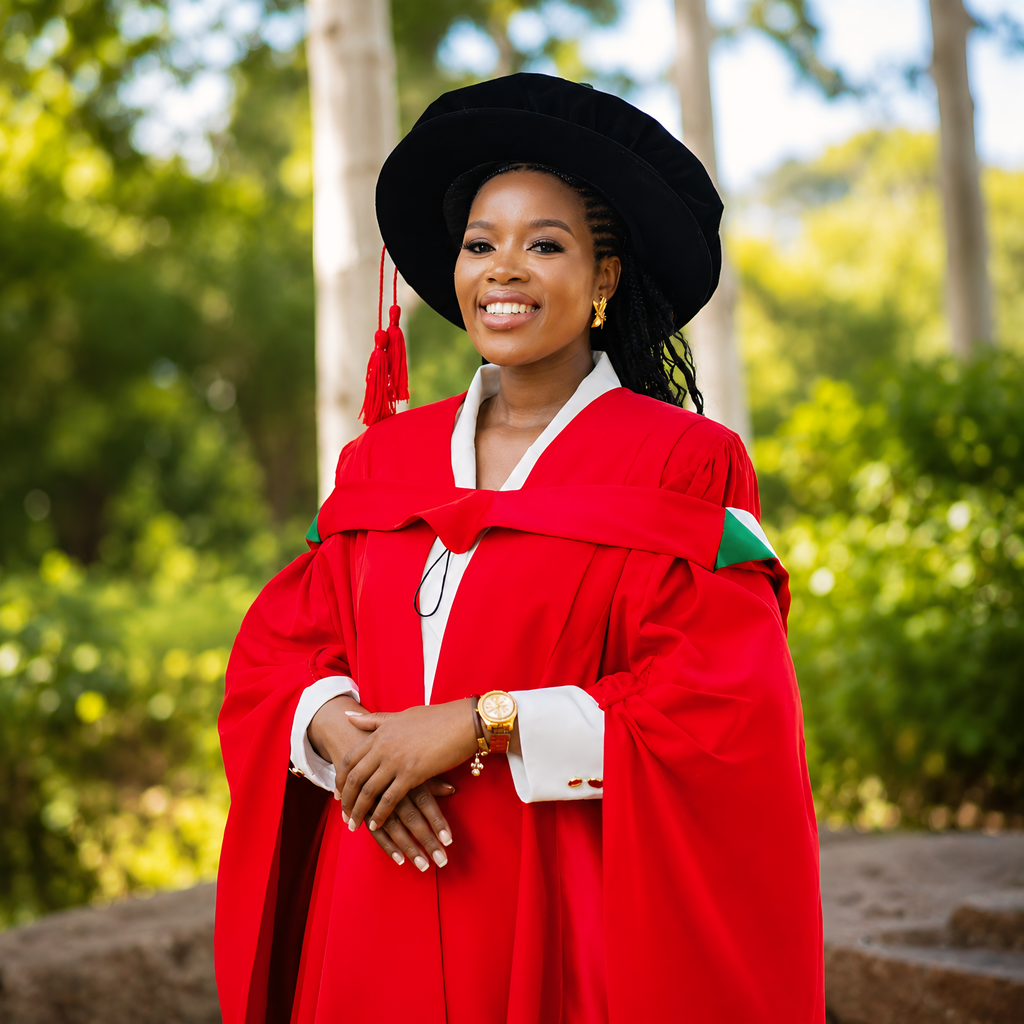
Zakithi is a PhD-trained virologist, medical communications professional, science communicator and content creator whose work has centred significantly on HIV research and making scientific knowledge accessible to ordinary people.
Her academic journey began at the University of KwaZulu-Natal, where she earned a Bachelor of Science degree in Genetics and Microbiology before completing an Honours degree in Microbiology.
She subsequently completed a Master of Medical Science in Virology, graduating cum laude in 2018.
She then progressed into doctoral research within the HIV Pathogenesis Programme at UKZN.
In May 2024, she was formally conferred with a Doctor of Philosophy (Medicine), specialising in Virology.
Her doctoral dissertation investigated the effect of an HIV-1 subtype C Tat A21P variant on viral transcription and latency-related mechanisms.
Behind that title lies years of painstaking scientific work.
Experiments.
Data.
Failed hypotheses.
Long hours.
Research papers.
Presentations.
Mentorship.
Persistence.
And the intellectual courage to continue asking questions when answers are not immediately available.
A Young Scientist Determined to Solve Big Problems
Zakithi’s interest in science was not simply academic.
She was drawn toward solving healthcare challenges.
The South African Department of Science and Innovation described her as a woman pursuing STEM with a mission to contribute to solving the HIV challenge.
Her research has included work on HIV-1 subtype C, an important area given the burden of HIV in southern Africa.
Her scientific work has also contributed to peer-reviewed research involving HIV viral genetics and transcriptional mechanisms.
But perhaps what makes her journey especially inspiring is that she realised something important:
Science has limited impact if people cannot understand it.
And so she became more than a scientist.
She became a science communicator.
Making Science Accessible
Zakithi has repeatedly advocated for communicating scientific knowledge in language that ordinary people can understand.
While discussing science communication, she said:
“I think it is so important to communicate our science to the people we do it for, which is the everyday person.”
That philosophy has become an important part of her professional identity.
She has used media, digital platforms, public speaking and educational engagement to make science more accessible.
Her work demonstrates that scientists do not have to remain behind laboratory doors.
They can become storytellers.
Educators.
Mentors.
Content creators.
Public intellectuals.
And bridges between scientific institutions and society.
Excellence Beyond the Laboratory
Zakithi’s achievements extend beyond her PhD.
She became the KwaZulu-Natal winner and a Top 10 national finalist in FameLab South Africa in 2021, a competition designed to help scientists communicate complex research to non-scientific audiences.
She was also recognised among South Africa’s Top 10 Young Outstanding Persons by Junior Chamber International in 2022.
In 2021, she was second runner-up in a Three Minute Thesis competition, demonstrating her ability to communicate complex doctoral research concisely.
She also won first place in a South African Association for Microbiologists presentation competition in 2016.
These achievements tell an important story.
Academic excellence is one thing.
The ability to communicate that excellence to the world is another.
Zakithi has pursued both.
International Exposure and Research Experience
Her scientific development has also included international research exposure.
During her postgraduate journey, she received opportunities to travel and present research internationally, including experiences in the United States and Europe. UKZN reported that her research development included conferences and research visits abroad.
Such opportunities matter because science is global.
A researcher may begin in Durban but contribute to conversations taking place in laboratories, universities and scientific communities across continents.
Zakithi’s story reflects that global dimension of African scientific talent.
From Scientist to Medical Communications Professional
After completing her doctoral training, Zakithi expanded her career into medical communications.
Her current professional profile describes her as a PhD-trained scientist and medical communications professional, with experience translating scientific knowledge into meaningful communication.
This represents another evolution in her career.
The laboratory taught her how to investigate.
The PhD taught her how to think deeply.
Science communication taught her how to explain.
Medical communications allows her to connect scientific evidence with the wider healthcare ecosystem.
Her journey demonstrates that a PhD does not have to lead to only one career.
A doctorate can become a platform from which an individual creates multiple forms of impact.
A Shared Commitment to Mentorship
Although Zamambo and Zakithi have pursued different disciplines, mentorship is one of the strongest threads connecting their journeys.
Zamambo’s African STEMinist work focuses on supporting African women in STEM.
Zakithi has similarly become involved in science communication, career guidance and encouraging young people to consider careers in science.
Zakithi has spoken about the importance of young people becoming future leaders and adapting to an increasingly complex world.
This is perhaps the most powerful part of their story.
They are not simply collecting qualifications.
They are helping others imagine themselves earning those qualifications too.
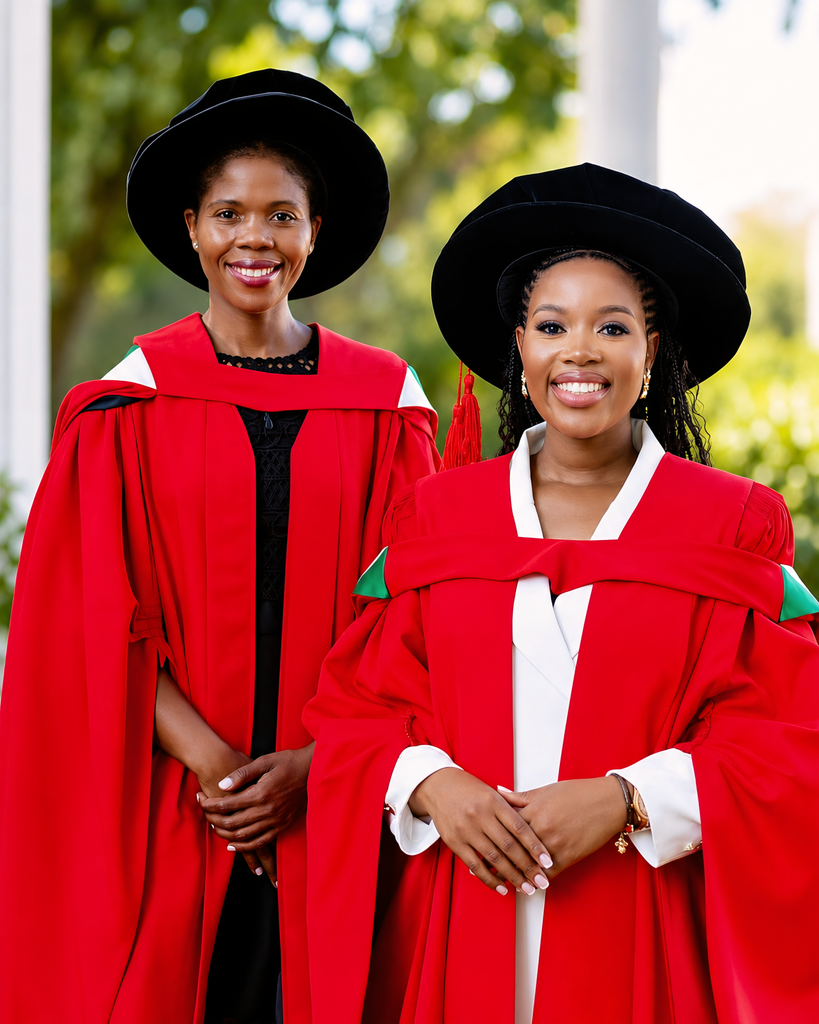
Sisters Who Turned Achievement Into Representation
In 2016, Zamambo earned her PhD.
Eight years later, in 2024, Zakithi graduated with her PhD from the same University of KwaZulu-Natal.
Their academic milestones created a remarkable family story: an older sister who had already crossed the doctoral finish line and a younger sister who followed years later.
But the significance goes beyond family pride.
Their story offers young African women something invaluable:
evidence.
Evidence that Black African women can become professors.
Evidence that African women can become researchers.
Evidence that African women can conduct advanced scientific research.
Evidence that African women can write books.
Evidence that African women can challenge institutions.
Evidence that African women can enter STEM.
Evidence that African women can become science communicators.
Evidence that African women can occupy intellectual spaces that historically excluded them.
Representation is powerful because sometimes people need to see the destination before they believe they can travel there.
Two Disciplines, One Philosophy
At first glance, Zamambo and Zakithi seem to have travelled completely different academic roads.
One studies gender, culture, law and African feminism.
The other studies viruses, HIV and medical science.
One works primarily in the humanities and social sciences.
The other emerged from the laboratory sciences.
Yet their careers reveal a common philosophy.
Knowledge must serve society.
Zamambo asks how institutions, cultures and social structures can become more equitable.
Zakithi asks scientific questions that can contribute to better understanding of health challenges while helping the public understand science.
Both recognise that knowledge becomes more powerful when it reaches beyond the university.
What Their Story Teaches Us
1. Excellence can have many forms
There is no single definition of brilliance.
Zamambo’s brilliance is expressed through critical scholarship, writing, research and advocacy.
Zakithi’s is expressed through laboratory science, virology, research and science communication.
Both are examples of intellectual excellence.
2. Representation changes what young people believe is possible
When young African women see people like themselves succeeding in fields that historically excluded them, the psychological barriers begin to weaken.
A role model does not simply say, “You can do it.”
A role model demonstrates:
It has been done.
3. A PhD should be a beginning, not an ending
For both sisters, the doctorate was not the conclusion of their journey.
It became a new platform.
For Zamambo, advanced scholarship opened further opportunities to research gender, STEM transformation and African women’s experiences.
For Zakithi, the PhD became part of a broader career spanning virology, science communication and medical communications.
The lesson is profound:
“Education is not merely about reaching a destination. It is about expanding the number of destinations available to you.“
4. Your discipline does not have to define the limits of your impact
Zakithi demonstrates that a scientist can also be a communicator.
Zamambo demonstrates that a gender scholar can also be an advocate and mentor.
Their careers challenge the idea that professional identity must fit neatly into one box.
The future belongs increasingly to people who can connect disciplines.
Inspirational Quotes From Their Journeys
Dr. Zamambo Mkhize
“The demographic changes but the environment still stays the same.”
Her observation is a powerful reminder that genuine transformation requires more than changing statistics. It requires changing cultures, systems and environments.
She has also spoken about the importance of African women in STEM and the need for greater representation because of the shortage of role models in fields that remain heavily dominated by white men.
Dr. Zakithi Mkhize
“I think it is so important to communicate our science to the people we do it for, which is the everyday person.”
And perhaps one of the most memorable descriptions of her doctoral journey came from Zakithi herself:
“Doing a PhD is like eating an elephant one bite at a time.”
The metaphor captures something every doctoral student understands.
Great achievements are rarely completed in one giant leap.
They are built one page.
One experiment.
One chapter.
One correction.
One presentation.
One rejection.
One breakthrough.
One day at a time.
The Legacy They Are Building
The greatest measure of achievement is not always the number of qualifications on a CV.
It is what those qualifications make possible for other people.
Dr. Zamambo Mkhize and Dr. Zakithi Mkhize are building legacies that extend beyond themselves.
Zamambo is contributing to scholarship that challenges how African women, gender, culture and higher education are understood.
Zakithi is helping make science more accessible while contributing to the scientific and medical knowledge ecosystem.
One is challenging social structures.
One is communicating scientific knowledge.
Both are expanding possibilities.
And both demonstrate the power of African women in intellectual leadership.
A Tribute to Two Remarkable African Women
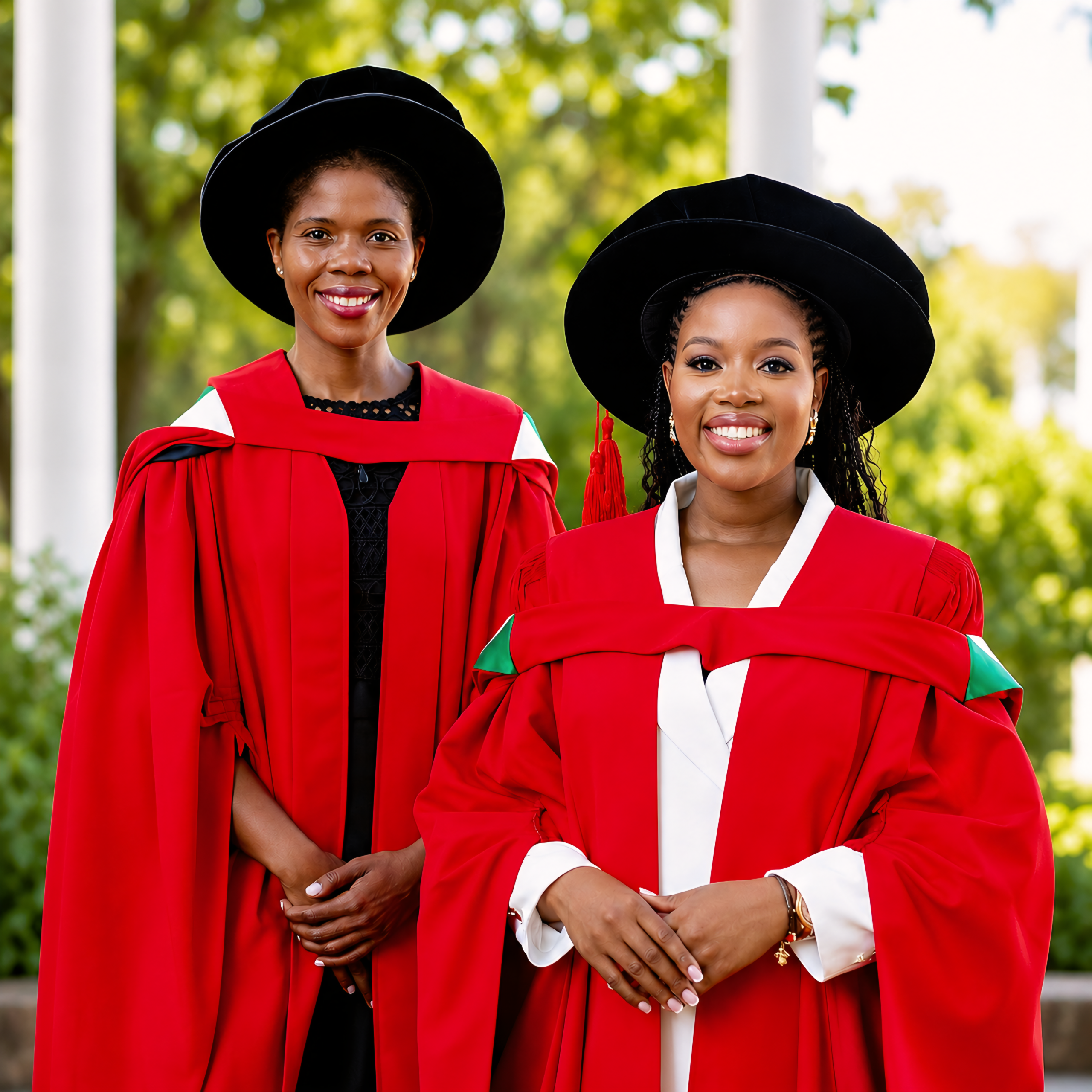
There is something deeply symbolic about two sisters standing together after years of academic struggle, research, sacrifice and perseverance.
One sister earned her doctorate first.
The other followed eight years later.
But the story is not really about who came first.
It is about what they built together.
A pathway.
A standard.
A legacy.
A reminder to young African women that the worlds of science, academia, research and intellectual leadership belong to them too.
Their journeys tell us that excellence does not have a single language.
It can speak through a laboratory.
It can speak through a book.
It can speak through a classroom.
It can speak through research.
It can speak through mentorship.
It can speak through a young woman watching from a distance and thinking:
“If she can do it, perhaps I can too.”
That is the real power of representation.
And that is why the stories of Dr Zamambo Mkhize and Dr Zakithi Mkhize deserve to be celebrated.
Not merely because two sisters earned PhDs.
But because they transformed education into purpose, knowledge into impact, and personal achievement into inspiration for the next generation.
The Women Power Africa Tribute
Women Power Africa celebrates Dr. Zamambo Mkhize and Dr. Zakithi Mkhize as remarkable examples of African women turning knowledge into power and achievement into impact.
Their stories remind us that Africa’s future will not be built only by those who inherit opportunity.
It will also be built by those who create it.
By researchers who ask difficult questions.
By scientists who pursue difficult answers.
By academics who challenge outdated systems.
By mentors who open doors.
And by women who refuse to accept that the spaces they were historically excluded from are spaces they cannot transform.
Dr Zamambo Mkhize and Dr Zakithi Mkhize have shown what happens when African women pursue excellence with courage, discipline and purpose.
Two sisters.
Two PhDs.
Two extraordinary journeys.
One powerful message to Africa’s daughters:
“Your background does not determine the height of your intellectual ambition.“
Your field does not determine the size of your impact.
And the doors that were once closed can be opened—not only for you, but for everyone coming after you.
This is excellence.
This is representation.
This is African women changing the world—one idea, one discovery, one student and one breakthrough at a time.